Near-death experience
Life After LifeNear-death experience is a conscious perceptual experience associated with an encounter in which a person could readily die, may be believed or pronounced clinically dead, and nevertheless survives. In Raymond Moody’s account, its importance lies both in the repeated features reported by different people and in the profound meanings they attach to them. He treats the accounts as a phenomenon to investigate, not as proof of what happens after bodily death, and stresses that no single sequence describes every person’s experience.
Definition and Range
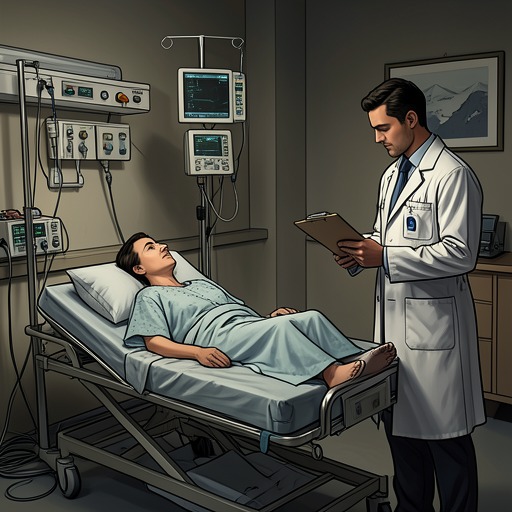
Moody distinguishes the experience itself from the encounter that provides its circumstances. A near-death experience is a conscious perceptual experience during a near-death encounter; the encounter is a perilous event survived despite the possibility of death, including cases in which the person is believed or pronounced clinically dead. The distinction matters because the reported experiences do not map neatly onto one medical threshold. People describe them across a wide spectrum of circumstances, from situations in which death seemed close to episodes of apparent clinical death.
Nor does every close encounter produce a remembered experience. Some people report nothing, and others recall no conscious experience even after apparent clinical death. Conversely, people have described similar experiences when they did not believe themselves near death or ill. Moody’s definitions therefore provide a way to discuss a broad class of reports, rather than a claim that all near-death events produce the same state.
A Recurring Pattern and Its Variations
To restate the model first assembled in Life After Life, Moody offers a theoretically complete experience that gathers the common elements into one sequence. In this model, a person reaches a point of severe physical distress, hears a doctor pronounce death, and becomes aware of a loud ringing or buzzing and rapid movement through a tunnel. The person then experiences being outside the physical body, sees the body from a distance, and watches attempts at resuscitation from that unusual vantage point. Emotional upheaval gives way, in time, to greater familiarity with the altered condition.
The model continues with the perception of a different kind of body, encounters with deceased relatives or friends, and the appearance of a warm, loving Being of light. That presence asks the person to evaluate their life and accompanies a panoramic review of its major events. A barrier or border appears to mark a limit between earthly life and what lies beyond it. Yet the person is told, or comes to understand, that the time for death has not arrived. Though reluctant to return and absorbed by feelings of joy, love, and peace, the person reunites with the physical body and survives.
The sequence is a composite, not a checklist imposed on every report. Since completing Life After Life, Moody says the original fifteen common elements continued to recur in the additional accounts he collected, while some less common features extended the pattern. People who return may struggle to find words for what happened; some encounter disbelief and stop talking about it. Despite those difficulties, Moody describes the experience as capable of profoundly changing a person’s views of death and its relation to life.
Review, Knowledge, and Bodily Experience
The life review can be experienced as a panoramic, wraparound, full-color, three-dimensional display. Some people describe seeing major events; others say that every action and thought was present. In some accounts, the review occurs in the presence of a Being of light, which prompts reflection on what the person has done with their life. Reports also describe seeing the consequences of one’s actions for other people. In this heightened state, selfish acts may bring deep regret, while memories of love and kindness bring satisfaction. The review is thus not merely a catalogue of remembered events: in the accounts Moody presents, it also discloses their moral and interpersonal consequences.
Another reported feature, which Moody calls a vision of knowledge, is a brief glimpse of a realm in which knowledge of past, present, and future seems to coexist, or a moment of apparent complete knowledge. Those who describe it say it cannot ultimately be expressed in ordinary language and does not persist after return; they do not bring back omniscience. Comparisons include a flash of universal insight, a school, or a library, but these are presented as imperfect descriptions rather than literal explanations. The experience, as reported, does not discourage further learning; it encourages it.
Bodily sensation also varies across accounts. Some people say they felt no pain while they experienced being outside the body, even when medical personnel were carrying out resuscitation measures. Some report that pain returned immediately upon re-entry into the physical body. These descriptions are reports of subjective experience, not a demonstration that the body was medically insensible or that any one explanation accounts for the phenomenon.
Inquiry, Interpretation, and Care
Moody’s growing collection of interviews led him to conclude that the phenomenon was widespread, while leaving open what it ultimately means. Other physicians, most notably Elisabeth Kübler-Ross, reported gathering accounts they regarded as similar, and people increasingly spoke publicly about their experiences after his lectures. Such convergence encouraged further inquiry; it did not, in his formulation, settle whether the reports establish survival after death. He cautions that human testimony can be honest and informative but does not by itself prove that question.
He also recognizes limits in the methods available. His study relied on reports from a sample not selected at random, and anecdotal accounts do not qualify as scientific evidence in the strict sense. Yet he argues that the difficulty of handling a widespread phenomenon with existing scientific methods should prompt the development of better concepts and methods rather than its automatic dismissal. Experimental investigation faces ethical and procedural limits: researchers cannot deliberately bring statistically significant numbers of people to clinical death in order to record their impressions after resuscitation.
The subject has a practical medical dimension for Moody because patients have shared these experiences in connection with medical care. During his medical education, two patients spontaneously described earlier experiences in ordinary clinical conversations: an elderly man being treated for a skin problem and a twelve-year-old boy with a congenital endocrine disease. Moody did not pursue either disclosure, in part because he regarded the clinic visit as focused on the immediate medical problem. Looking back, he felt that he had missed an opportunity to reassure them that others had reported similar experiences. He recommends a sympathetic approach: acknowledge that such reports exist, avoid claiming scientific or medical certainty about their meaning, and recognize that the experience may matter deeply to the person who recounts it.
That attention also bears on care during resuscitation. Moody notes that patients have sometimes recalled remarks made by medical personnel during attempts to revive them, and he relays the practice of one physician who stayed with patients for a time after death and spoke to them, despite believing the experiences were physiological processes continuing in the brain. The possibility that patients may later report hearing such remarks makes care in speech relevant even when recovery seems unlikely. At the same time, Moody says the research does not warrant conclusions about the ethical dilemmas of artificially sustaining life after irreversible impairment of brain function.